Ancient Greece Vocabulary for Kids
Ancient Greece Vocabulary for Kids: English Words and Activities introduces English terms for Greek places, people, daily life, stories, and government. Children start with concrete words such as temple, ship, and pottery, then progress to democracy and myth. The goal is to understand each word, use it in a sentence, and practise through games, drawing, sorting, speaking, and short writing. Adapt the activities for ages 4 to 15.
📥 Ancient Greece Vocabulary Practice
Learn and use useful words about ancient Greek places, people, culture, and daily life.
Leave your email — we'll send the PDF to your inbox.No spam — the PDF plus one short reminder. Unsubscribe anytime.
Core Words and Phrases
Start with nouns children can picture or act out. Group words by meaning to ease recall. This vocabulary set introduces Ancient Greece Vocabulary for Kids: English Words and Activities.
Teach verbs beside the nouns: build a temple, sail a ship, shape pottery, trade goods, tell a myth, and vote in an assembly. Children learn phrases instead of isolated labels.
Using the Words in Context
Short sentences show how words behave in English. In Ancient Greece Vocabulary for Kids: English Words and Activities, examples should precede definitions: “The ship entered the harbour.” “The potter shaped the clay.” “The actors wore masks.” “Citizens met in the agora.” Older learners can add detail with because, but, or while.
Past-tense examples connect language with history: “Athletes competed at Olympia.” “Merchants traded olive oil and pottery.” “People watched plays in open-air theatres.” Explain that a myth is a traditional story, not a lie. The distinction supports sentences such as “The myth explains how the hero faced a difficult task.”
Build a Three-part Sentence
Choose a person, action, and place: “The athlete trained near the temple.” Change one part: “The soldier walked through the agora.” Ask which sentences sound possible and which need correction.
Activities for Different Ages
One vocabulary set can serve each age group. Adjust the thinking task, not only the word count. A younger child may match a ship to ship; an older learner can explain why harbours supported travel and trade.
For multilingual children, invite comparisons without making translation the test. Words related to theatre, democracy, and philosophy appear in many languages. A familiar root aids recognition, but children should practise each English word in a full sentence.
A Simple Practice Routine
A steady routine makes Ancient Greece Vocabulary for Kids: English Words and Activities easier to remember than one long session. Practise five to eight words across multiple days. Start with recognition, progress to speaking, then ask children to recall a word without seeing it.
Quick tip: Put pictures on one card set and English words on another. Matching separate cards demands stronger recall than reading labels below pictures.
Weekly practice checklist
- Choose one word group for the week.
- Read each word aloud in a short phrase.
- Match every word to a picture or definition.
- Use at least four words in spoken sentences.
- Review the words after a one-day gap.
- Finish with a drawing, quiz, or short paragraph.
Try quick games. Hide a word card and ask what is missing. Play “odd one out” with temple, harbour, athlete: two are places, and one is a person. For speaking practice, describe a word without naming it: “People bought and sold things here.” The answer is market or agora.
Common Mistakes to Avoid
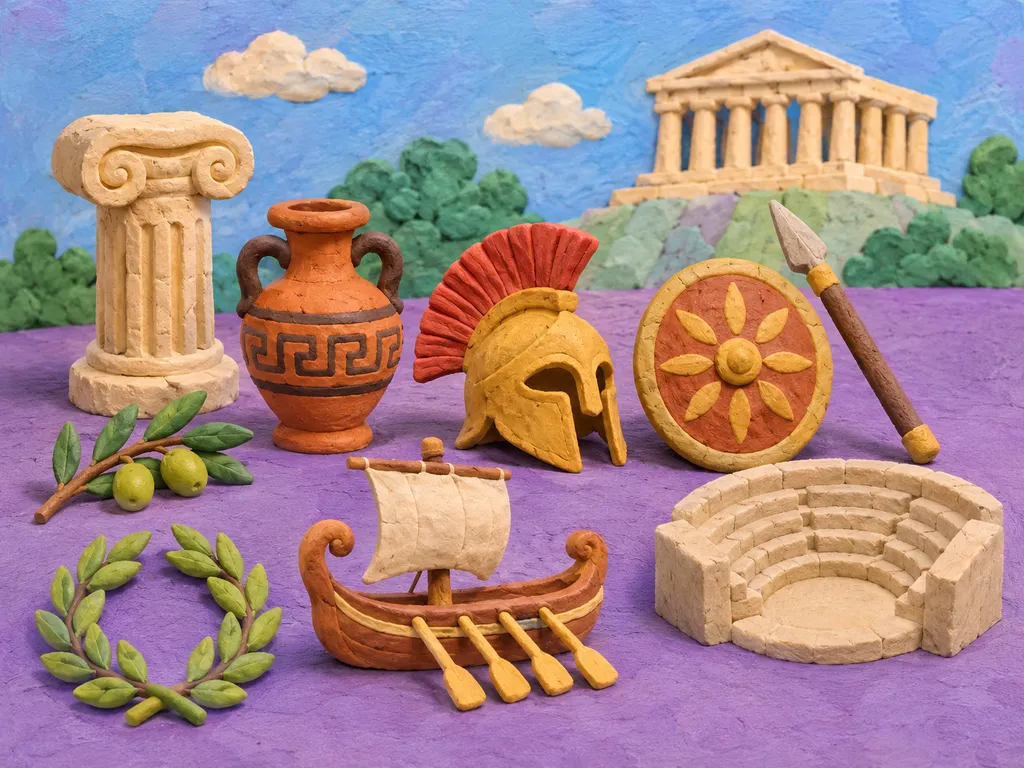
Too much unfamiliar vocabulary turns practice into guessing. Start with visible objects and places, then introduce abstract terms. Before defining democracy, young learners should use vote, law, and assembly.
Another mistake is presenting ancient Greece as one uniform society. Athens and Sparta were separate city-states, and life differed by place and period. Keep explanations brief and accurate: “Athens used a form of democracy, but most people living there had no political rights.”
Correct language errors gently. Children may say “a pottery” instead of “a pot,” or use myth for any false statement. Model the correction and continue: “The museum has Greek pottery” or “This myth tells a story about a goddess.”
Key distinctions
Myth: Athens and Sparta were the same kind of place.
Fact: They were separate city-states with different social and political systems.
Myth: Every adult in ancient Athens could vote.
Fact: Political rights were limited, so the ancient system was not the same as a modern democracy.
- Choose five Ancient Greece words and review them with picture cards.
- Match each word to one image before asking your child to spell it.
- Read a Greek myth together and underline three familiar vocabulary words.
- Avoid correcting every error; model the word naturally in a complete sentence.
- Finish by asking your child to explain two words without prompts.
When a word has several meanings or pronunciations, Cambridge Dictionary is a useful check before turning it into child-friendly examples.
Frequently Asked Questions
How Many Ancient Greece Words Should a Child Learn at Once?
When using Ancient Greece Vocabulary for Kids: English Words and Activities, start with five to eight related words. Younger children may need fewer; older learners may manage more familiar terms. Keep the set until your child recognises the words and uses several without prompts. Review after a short gap before adding another group.
Is This Vocabulary Suitable for a Child Who Speaks Several Languages?
Yes. Multilingual children can notice shared roots and compare meanings. Let your child use another language to clarify a difficult idea, then return to an English phrase or sentence. Do not test direct translations alone. Practise words such as temple, harbour, and democracy in English.
Does a Child Need to Learn Ancient Greek Words?
No. The goal is English vocabulary connected with ancient Greece. Introduce agora and acropolis because they appear in English history materials. Explain them in plain English and practise them in context. General English activities do not require detailed ancient Greek spelling or grammar.
How Can Vocabulary Practice Support a School History Lesson?
Choose words from the topic your child is studying, then practise them before and after reading. Previewing ship, harbour, and trade makes passages about sea travel easier to follow. Afterwards, request a labelled picture, oral summary, or short comparison to check historical understanding and English use.
Choose five words today, use each in a spoken sentence, and review them after one day. Add a new group when your child can use at least four words without prompts.
A short one-to-one lesson can show what level and pace fit your child — book a trial English lesson.
Stay updated on our latest tips and resources by following us on Instagram LearnLink.